Friday, November 20, 2020

Does Genesis 1 communicate cosmic history?

In John Walton's The Lost World of Genesis One, he puts forward 18 propositions regarding how Genesis should be interpreted in the light of Ancient Near Eastern culture.

Proposition 1 states: Genesis 1 is ancient cosmology.  This proposes that Genesis 1 does not attempt to describe cosmology in modern terms or address modern questions.  It contains no revelation to improve the scientific understanding of the ancient Israelites.

In saying this, Walton is primarily referring to what he terms cosmic geography.  Cosmic geography deals with such questions as: the shape of the earth, the nature of the sky, the location of the sun, moon, and stars.  Walton criticizes concordism because it tries to connect the terminology used in Genesis 1 with modern scientific terms.

Concordists believe, asserts Walton, that the Bible must agree--be in concord with--all the findings of contemporary science.  Personally, I think Walton is overstating what concordists claim, but I agree that caution is necessary.

Given this warning, is it yet appropriate to talk about cosmic history in contrast to cosmic geography?  If God was not trying to improve the Israelite concept of the natural world, was He instead trying to tell them something about its past history?  After all, Genesis 1 starts with "In the beginning God..." and not "At the center God...".  The toledot in Genesis 2:4 reads "These are the generations of the heavens and the earth when they were created, in the day that the LORD God made the earth and the heavens." ESV  This toledot is taken by some scholars to be a summary of the preceding text.  The word toledot is alternately translated as historical records.  Furthermore, the content of Genesis 1 lays out a sequence of Days, typically observed as implying a sequence of events.

From this discussion, we should not rule out that God did mean to improve the Israelite's understanding of the history of everything, namely cosmic history, even if God did not address cosmic geography as defined by Walton which is also understood as the snowglobe problem of Ancient Near Eastern cosmology.

Therefore, if we scope a concordist approach that primarily focuses on the scientific history of Earth, we are contending with a different set of concerns.  This consideration allows for formulation of a new hypothesis: What was the meaning of evening and morning in Ancient Near Eastern culture and the significance of the Days of the creation week?

In our modern culture, we are quick to think literally in terms of daylight hours followed by a sunset, nighttime, and sunrise.  But that is exactly the kind of modern literalism that Walton warns against.  In the ANE, the focus might have been drawn to God's work of creation being punctuated by periods of darkness.  No other ancient creation story features this metaphor.  The darkness implied by evening and morning communicates chaos and what Walton might label as either non-order or disorder.

Not until the creation is complete and very good can the ANE culture think of the benefits of nighttime.  The sun goes away, only to return.  Darkness is no longer a time of chaos but a time of rest.  But, at the start of the story, the darkness was one of the first aspects of non-order that God addressed.

The period bracketed by evening and morning in Genesis 1 is not directly labeled as darkness or night.  Those terms are already used and contrasted: light vs darkness; Day vs Night.  The separation between the light and darkness is established on Day 1 -- one degree of order achieved.  But the rule over light and darkness by the greater and lesser lights is not achieved until Day 4 -- a higher degree of order achieved.

This frees evening and morning to serve another narrative purpose: that of highlighting a period separating each day of creative work - a time of non-order or disorder.  In the not-yet-fully-ordered cosmos, the periods separating each day may represent chaos events or times when some level of non-order is allowed or disorder is eliminated.  Think of it this way: the Earth starts out in a state of chaos or non-order;  God introduces some order; then He switches gears to address disorder (which can also be thought of as contrary-order or anti-order) which could entail allowing some level of non-order to return; God steps in again and introduces the next higher level of order; this process repeats.

In the ANE mind, this could prompt understanding the preparing of the heavens and the earth for humanity as occurring in phases.  In modern cosmic history, what we would describe in terms of the geologic record, we see a similar pattern.  The early earth is chaotic - scientists term this phase the Hadean for good reason - hellish conditions prevailed.  By degrees the Earth evolves into a more habitable world.  None-the-less, this progress is not smooth.  There are periodic set backs and dramatic chaos events that occur.  Some of these include the Late Heavy Bombardment, the Great Oxygenation Event, the Great Unconformity, and a series of major Extinction events.

Do any of these geologic events coincide with Genesis 1 chaos events?

Revelation is replete with chaos events leading up the the new heavens and the new earth.

The second angel blew his trumpet, and something like a great mountain, burning with fire, was thrown into the sea, and a third of the sea became blood. Revelation 8:8

While this refers to a yet future event, and could possibly be metaphoric, it certainly brings to mind a past event - when a fiery comet crashed into the Yucatan Peninsula 66 million years ago leaving behind the Chicxulub Crater and wiping out all the dinosaurs along with 75% of all species on Earth.  This event marks the boundary between the Cretaceous (K) and Paleogene (Pg) periods as defined by geology.

What happened immediately following this event? The origin of all modern birds and the dramatic proliferation and diversification of teleost fish, which now comprise 96% of all extant fish species.

This sounds a lot like a biblical chaos event followed by God's creative intervention.

And there was evening and there was morning, the fourth day.  And God said, "Let the waters swarm with swarms of living creatures, and let birds fly above the earth across the expanse of the heavens." Genesis 1:19-20

Immediately after the K-Pg Extinction event, the waters were in dire need of swarms of living creatures. Virtually nothing that could fly still lived, save perhaps some species of insects.  As few as 7 species of birds survived according to some estimates.  Yet from these few survivors, all modern birds were apparently formed.

God's decree explains what happens next and attributes the restoration to His work.

Let's have a look at how to apply this hypothesis by thinking about dinosaurs.

So what about the dinosaurs?  God created them too.  For a while (even just 24-48 hours ,YECs?) the dinosaurs stomped around digging holes in the ground, eating fruit, and outputting fertilized seeds.  But God saw that just as it would be not good for the man to be alone in the Garden, it would also be not good for man to have to deal with dinosaurs.  The description of the Leviathan in Job 41 makes it clear that God created some creatures for which man was no match and no ruler.  Having a few of them around might be permissible but not like during the reign of the dinosaurs.  Having served their purposes, God allowed the night to claim them.

So the question is, Is this approach to concordism valid?  Can one think of God revealing something of cosmic history while not addressing cosmic geography?  What do you think?


Thursday, November 19, 2020

Question about Ornithology and Mass Extinction on PeacefulScience.org

I have been enjoying an engaging dialog over on PeacefulScience.org with Avian Phylogeneticist John Harshman about the development of birds following the K-Pg mass extinction event.

According to John Harshman, "all modern birds are post-K/T species".  

(K-T and K-Pg are the older and newer names for the extinction event that wiped out the dinosaurs.)

I mentioned two boundary dates: K-Pg which is 66 million years ago and the Eocene-Oligocene which is 34 million years ago.

When asked if most genera of modern flying birds evolved between the K-Pg and the E-O, he said no.  Most genera (a grouping just above species) are Miocene or later (making them relatively recent).

According to Harshman, the minimum number of bird species to survive the K-Pg was around 7.  From these 7 all the thousand of modern bird species are derived, including flightless birds.

The impact of the E-O extinction on birds probably cannot be easily determined at this point due to a shortage of quality fossils.

We discussed whether the Biblical term "kind" had much to correlate to in the phylogenetic structure.  We agreed that phylogeny is just based on convenience with no "true" nodes.

At one point, I suggested that:

"God created every winged bird according to its kind" simply means God instigated every speciation event of birds.

To which he replied:

You can certainly believe so, in the sense that God could have caused every apple to fall from its tree, every rainbow to form, and every sand grain to reach the beach.

Ultimately, John Harshman's opinion of trying to align science and the Bible is summed up as follows:

Any attempts to match Genesis 1 to reality is doomed to ignominious failure. 

Although he is very skeptical of the concordant approach to creationism and labels himself a secularist, it was none-the-less interesting to hear his objections.   This has spawned ideas in my head for improving my model.

He also pointed me to timetree.org a web site that is useful for exploring the phylogenetic relationship between species.  To use the website effectively, you also need to know official Taxon names.  For birds, some of those can be found here: https://www.worldbirdnames.org/new/updates/taxonomy/

My Take Away

I think it is fascinating that all birds alive today descended from as few as 7 species surviving the K-Pg extinction event that wiped out the dinosaurs and 75% of all species.  This reminds of the recovery after the Flood of Noah.  It makes me think of the K-Pg as a harvest or reaping of all that was good.

As I am also reading John Walton's Lost World of Adam and Eve, I am reminded that in Ancient Near Eastern culture, the night and darkness are associated with chaos and non-order.  I wonder if the "Evening and Morning" phrase in Genesis 1 refers to the night, a time of darkness, between each Day of creation.  This would make the night a Chaos Event, a time when God eliminates all that He has made that He is basically through with.

Can we think of the K-Pg Extinction Event precipitated by an astroid strike as a Chaos Event separating Day 4 from Day 5 of the creation week?

In this sense God kept the land and seas and seed plants and fruit trees of the Third Day because they were good, but He eliminated the dinosaurs because He was done with them - they were not good for what He had in mind to create next.

I will take this question, in some form, back to the PeacefulScience.org discussion forums for a group think.


Monday, October 12, 2020

What Kind of Story is Genesis 1

The following content was originally written as a response to a Reddit post.

The Genesis 1 account is a story. That is how it would have been experienced. A parent or teacher or elder would recount the story of the creation of the world by God to a listening audience. It would be intended as a moral Truth story. The storyteller would expect the audience to believe and be guided by the story, to find in it comfort and instruction. That would be the purpose of telling the story and faithfully handing it down from one generation to the next. Such a story is meant to be taken as Truth and therefore not freely modified as one sees fit, but rather related in full and with precision.

We call a true story a narrative and the three modifiers tell us what kind of story. First of all, it is clearly a poetic story. That is different than being a poem. In this case poetic means that the story employs metaphor and structure. It utilizes inclusiowhich is to wrap a concept in an envelop structure. It also utilizes chiastic structure which is the organization of concepts in the A-B-B-A repetition. The repetition and structure of Genesis 1 is quite obvious, even though the text is written as a narrative rather than as a poem.

To say that it is historical is to state that the events of the story represent true history. That is, God actually performed each of the creative miracles described at some point in the past. It also implies the general sequence of events is meaningful. There really was a time when these things happened.

To say that it is an epic telling is to recognize that the sweep and scope of the story is both very grand and very profound and that the author employed elements of epic story telling. One of the elements is that of epic regression which we see in Genesis 1:14-19 which narrates the Fourth Day and harkens back to "let there be light" of Day 1 and the "heavens" of Day 2. The telling of the events of Day 4 in which the lights begin to mark days and years and serve as signs for seasons is couched in terms that relate back to the original appearance of light, the demarkation Day and Night, and the formation of the Heavens. Without recognizing the employment of epic regression one might mistakenly think that all the events are crammed into Day 4. We also see parallelism between seas and land of Day 3 and the filling of the seas and land on Days 5 and 6. The parallelism does not negate the sequence of events but points to the purpose of the sequence. Another element of the epic is that the narrative relates the events in sweeping, encompassing terms in order to avoid a massive list of specific details. This means that we must interpret the events as generalizations.  Most birds were created on Day 5, most plants on Day 3, etc. Exceptions here or there would not be the point. It is an epic. If an epic were relating the progress of a war it would gloss over many battles and merely hit the highlights, the true turning points of the war, not every maneuver. That is what we have in Genesis 1 as an epic.

We could add to all of this that Genesis 1 is a polemic. A polemic is an attack or a defense. The author is basically saying, "Let me tell you how it really happened." This narrative is put up against other competing creation narratives and is being put forth to set the record straight. It argues against competing ideas of polytheistic creation stories. The six days of creation may be set against the six gods of Sumerian creation mythology. The reason why some parallels are seen between Sumerian creation stories and Biblical creation stories is likely because the Biblical accounts are written to counter the Sumerian accounts. This points to these stories being very ancient, likely authored about 2000 BC or so.

So there you have it. Genesis 1:1 to 2:4 is summarized in the colophon captured in Genesis 2:4 and was written about 2000 BC, likely on a clay tablet, in the epic, historical, poetic narrative literary genre to serve as a polemic against false creation mythologies and in being revealed by God, the True Creator, also conveys key elements of the actual history of Earth.

Wednesday, September 30, 2020

Science Update: Days 5 & 6 revealed in high-fidelity climate record

Genesis 1:1 - 2:4 The Epic Creation Narrative

The epic creation narrative of Genesis chapter 1 begins with these profound words, "In the beginning, God created the heavens and the earth", and is summarized by the colophon in verse 4 of chapter 2:

These are the generations of the heavens and the earth when they were created, in the day that the LORD God made the earth and the heavens.

How can there be multiple generations in the day when God made earth and heavens?  We will lean on Moses, the man of God for insight.  In Psalm 90 Moses writes:

2 Before the mountains were brought forth, or ever you had formed the earth and the world, from everlasting to everlasting you are God.

4 For a thousand years in your sight are put as yesterday when it is past, or as a watch in the night.

Thus the time frame of the six cycles in the Genesis epic creation narrative are on God's timeline, not on a human timeline.  The repeated pattern characterized by one or more decrees and descriptive statements followed by an evening-morning demarcation can be metaphorically called either a day or a generation.  From God's perspective, it is as if all of these days or generations constitute a single day, or single time.  Hence the summary phrase "in the day the LORD God made the earth and the heavens" encompasses the entire six-day period.

The point of this textual analysis is to demonstrate that Genesis 1 describes six demarcated eras of creative activity of indeterminate length but of significantly progressive nature.  We wonder then, Can these "days" indeed be seen in the geologic history of the Earth?

When geology was in its infancy as a science, the answer would clearly have been "no".  Without adequate knowledge and characterization of the past, humans could have no better idea about the order of creation than that provided by the text of Genesis itself.  Genesis 1 is still the gold standard of creation narratives because it tells us who created and why the creation exists.

As geology developed, the answer morphed from "no" to "maybe", even passing perhaps through "certainly not" from some perspectives.  This is because the art of reconstructing past history from artifacts and scientific models is like the assembly of a puzzle for which the box top has been misplaced and some pieces are fit together wrongly and others are missing.  Only later, when more pieces are set aright can the overall image begin to take on meaning.  I believe that the answer has become "yes".  It has finally become possible to see the major outline of Genesis 1 in the geologic record of Earth's history as pieced together by modern science.

Summary of Genesis 1 and Geologic Timeline Harmony

  • Hadean Eon: 4.5 to 4.0 BYA - corresponds to the time when Earth was Formless and Void
  • Archean Eon: 4.0 BYA to 2.5 BYA - corresponds to Day 1: it is the era of light and photosynthesis
  • Proterozoic Eon: 2.5 BYA to 650 MYA - corresponds to Day 2: development of the atmosphere
  • The Phanerozoic Eon from 650 MYA to present is divided into three major periods
    • Paleozoic Era: 650 MYA to 100 MYA - starts out Day 3: continents with land plants form; trees bearing fruit created; also dinosaurs are created
    • Mesozoic Era: 100 MYA to 66 MYA -  wraps up at the end of Day 4: days are 24 hours long, climate is seasonal; dinosaurs go extinct
    • The Cenozoic Era from 66 MYA to present is divided into two major periods
      • Paleogene Period (excluding the Oligocene Epoch): 66 MYA to 34 MYA - corresponds to Day 5:  earth replenished with birds and the oceans with fish after the K-T extinction that wiped out dinosaurs and 75% of species; ancient mammal that later go extinct are also created on this day
      • Neogene Period (including the Oligocene Epoch and Quaternary): from 34 MYA to 0 MYA - corresponds to Day 6: the origin of modern mammals and of human beings

Each Creation Day ends with or contains one or more Extinction Events that corresponds to a Reaping that then provides the Seeds for the next Creation Day.  For example, at the end of the Day 4, God mows down all the dinosaurs preserving only one or a few species of tiny birds from which he forms all the other kinds of birds on Day 5.  Many scientists mistakingly think this occurs by a naturalistic evolutionary process, but in reality this is God's husbandry at work as He develops many new kinds of animals from just one.  In somewhat the same way that dog breeders have created many breeds from one original wolf species in thousands of years, God, over millions of years, creates many new kinds of animals from each original species.

Day 5 and Day 6 In Focus

New research carried out by scientists at the University of California at Santa Cruz may buttress the Ages of Joy creation model for Creation Days 5 and 6.  In the article High-fidelity record of Earth's climate history puts current changes in context, a continuous and high quality climate record stretching back 66 million years into the past is described.  The research article was publish in Science on September 10.

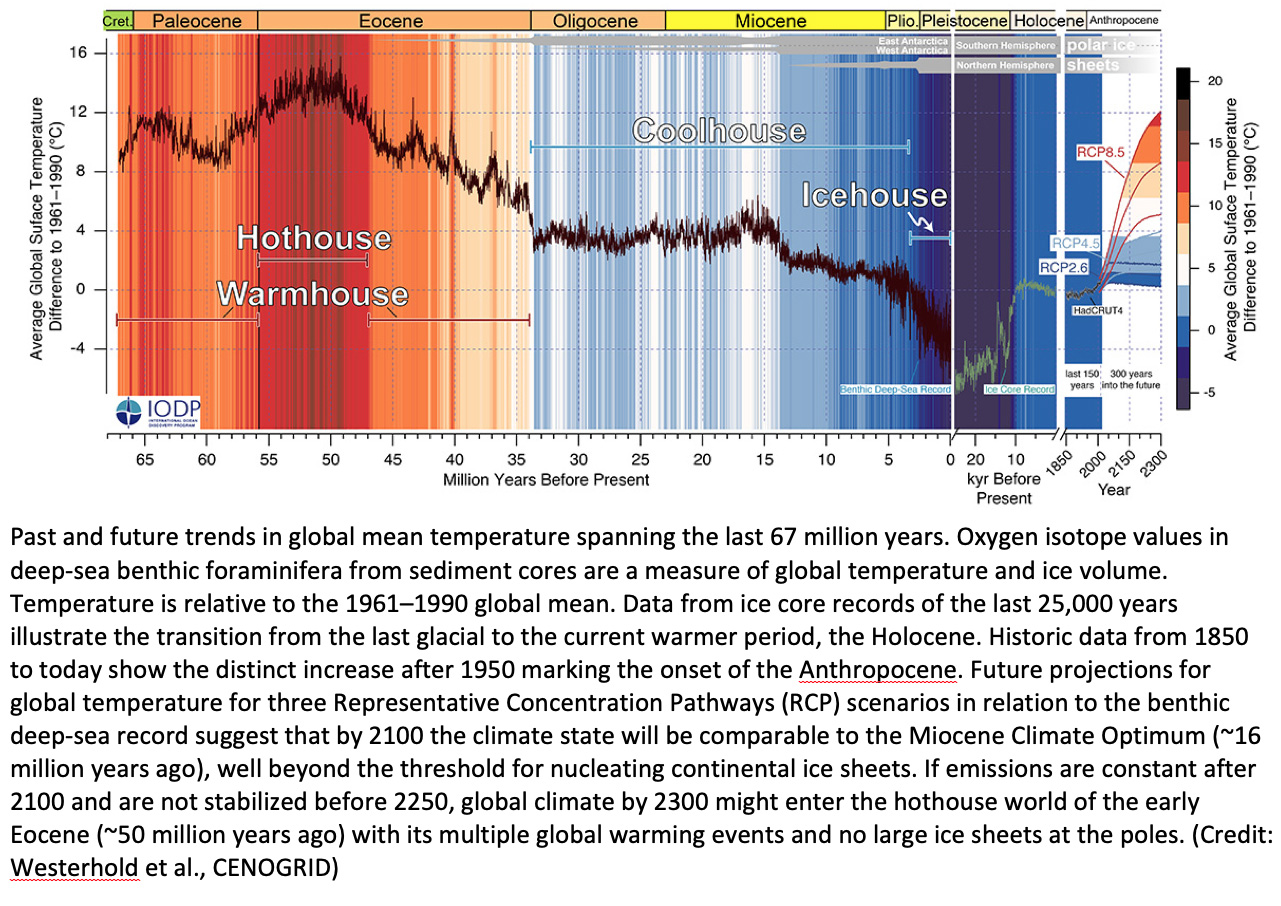
A graphic image (Credit: Westerhold et. al., CENOGRID) provided in the article shows two distinct phases of Earth's climate.


The Fifth Day

From at least 66 million years ago to about 34 million years ago, the Earth experienced what is called Hothouse and Warmhouse climate conditions.

The so-called K-T extinction event occured 66 million years ago and is the point in time marking the extinction of the dinosaurs and of 75% of all species on Earth.  In the Ages of Joy creation model, it corresponds to the end of the Fourth Creation Day and the beginning of Day 5.

On the Fifth Creation Day, God said, "Let the waters swarm with swarms of living creatures, and let birds fly above the earth across the expanse of the heavens." Genesis 1:20

This statement from the Bible corresponds to the dramatic recovery of life on Earth following the mass extinction event that terminated up to 75% of all species of life on the planet.

During this recovery, God created all the kinds of flying birds known today.  God also caused teleost fish that swarm in the oceans to dramatically flourish, becoming 96% of all existing fish species.

It was the K-T extinction event (the metaphorical evening and morning of the Fourth Day) that opened up environments to flourish with all the new kinds of animals that God would create.

While there were also new kinds of mammals created during the Fifth Day, these largely when extinct and were replaced on the Sixth Day with the animals we know today.  In sharp contrast, most of the bird and fish species that took hold during the Fifth Day continue to flourish until the present time.

The Hothouse and Warmhouse climates were ideal for the flourishing and taking hold of birds, fish, and large marine mammals like whales and dugong.

The Sixth Day

In contrast to the birds and fish, the transition to the colder Coolhouse and Icehouse climates of the Sixth Day was hard on land animals.  Many species when extinct.  This phenomena is called the Mongolian Remodeling when describing Asian species and the Grand Coupure when referring to European species.  It occurred approximate 33.9 MYA and is labeled the E-O (Eocene-Oligocene) Extinction Event and corresponds to the figurative morning and evening of the Fifth Day.  Scientists regard it as the most significant global biotic reorganization since the K-T extinction event that wiped out the dinosaurs.

Just as the Fourth Day transitioned into the Fifth Day at the K-T extinction event, so also the Fifth Day transitioned into the Sixth Day at the O-E extinction event.

On geologic timelines, the Paleogene Period runs from 66 MYA right across this important O-E Extinction event through the Oligocene Epoch to 23 MYA, at which point the Neogene Period begins.  In hind sight, scientists would have been better off ending the Paleogene (meaning older kinds) at 33.9 MYA and starting the Neogene (meaning newer kinds) at that time.  None-the-less, the Bible provides the proper breakdown and we can still see the correspondence between Genesis 1 and the geologic timeline despite these issues.

At just the right time, starting about 34 MYA at the dawn of the sixth day, God introduced dozens of new varieties of plants utilizing a more efficient form of photosynthesis, call C-4 photosynthesis.  He also introduced grasses to the environment using C-4 photosynthesis.  These plants were the ideal food for the new cooler, dryer climate and the new kinds of grazing animals God created which the new kinds of wild animals would hunt.

While God had created many kinds of plants, including fruit trees, on Day 3 (back during the Paleozoic and early Mesozoic), He now turbo-charged those same kinds of plants from the original C-3 photosynthesis to C-4 photosynthesis.  The blessing on the Sixth Day of man and animals with green plants is significant in this context.
29 Then God said, “I give you every seed-bearing plant on the face of the whole earth and every tree that has fruit with seed in it. They will be yours for food. 30 And to all the beasts of the earth and all the birds in the sky and all the creatures that move along the ground—everything that has the breath of life in it—I give every green plant for food.” And it was so.

Summary

The Cenozoic Era from 66 MYA to the present corresponds to Day 5 and Day 6 in Genesis 1 and this detailed climatic record clearly shows the two major periods into which this time is sub-divided.  During the first warmer period, all new species of birds rapidly arose after the K-T extinction and swarms of teleost fish exploded across the oceans to fill the vacated spaces.  Also, large marine mammals such as whales and sea cows became established in the oceans.  When the climate rapidly and permanently cooled, a major extinction event occurred specifically affecting land animals.  God replaced them with new kinds of land animals as described in the narrative regarding Day 6 in the Bible.


Friday, September 4, 2020

Bringing the "Image of God" into Focus, Science Update: Stone Tools

The publication of a recent study characterizing changes over time in stone toolkits used by early humans allows some insight into when God may have bestowed the Image of God on humankind through the special creation of Adam and Eve.

One of the mind boggling and often times confusing discoveries of modern science is that human-like creatures have existed on Earth for hundreds of thousands of years.  And yet, these so-called "early humans" repeatedly failed to "take dominion" over all the Earth.  They also failed to manifest the kind of creativity and dynamic discovery and technology development abilities that we now commonly take for granted in human beings.  At some point in time, God created a new kind of "human animal", one that bore His image and was designed to fulfill a spiritual destiny unlike any creature before.

In this post, we will explore an article titled New neural network differentiates Middle and Late Stone Age toolkits to see if we can discern when the "new humans" became active on Earth.

The article details the application of machine learning to characterize attributes of stone tools and identify what differentiates Middle Stone Age and Late Stone Age toolkits and when those changes occurred.

The oldest of what are termed Middle Stone Age toolkits date to about 300 thousand years ago and occur with the earliest Homo sapiens fossils.  MSA tools remain in use until about 30 thousand years ago.  In contrast, Late Stone Age toolkits show up about 67 thousand years ago and continue in use until the recent past.  This transition is considered a major cultural change, and is therefore interesting in terms of identifying when God created human beings in His own image.

In particular for this study, tool assemblages from Eastern African sites where used because of the rich collection of stone tools from well excavated and dated archeological sites.  Toolsets spanning from 130 thousand to 12 thousand years in age were used for the study.

The findings of this study are consistent with the concept that God created Adam and Eve in the Middle East around 70,000 years ago and that their offspring gradually spread throughout the Earth, including back into Africa.  By 67,000 years, humans bearing the Image of God may have migrated back into Africa, admixing with existing populations.  By 30,000 years ago, all non-image bearing human populations would expire.

Another tantalizing possibility is that the very last, most clever, of the "pre-image bearing humans" were created around 67,000 years ago in Africa, bringing the LSA toolkit with them and that Adam and Eve were created after them.  Resolving the question of when God bestowed His image on humans cannot be fully resolved by this one study alone.  But it does highlight a time period of critical interest.  In this series, I am using the anthropological marker of "moral story telling" to attempt to diagnose when Image-Bearing humans first appeared.  It is not clear that the difference between MSA and LSA toolkits identifies this transition.

One possibility that I am exploring is that God created human beings with the "substantive" ability to bear His image around 70,000 years ago, possibility in East Africa.  But only later, in Adam, did God also grant the functional (dominion) and relational (moral story telling) aspects of the Image of God.  These first might be the "sons and daughters of man" in one sense while Adam and Eve's offspring were the "sons and daughters of God".  Again, this study alone cannot validate or invalidate this theory, but does point to 67,000 years ago as an interesting time of transition.


Science Update: Origin of Earth's Oceans

This post examines possible implications of the discovery of "wet meteorites" and the origin of Earth's oceans.

The Bible contains several descriptive accounts about the creation of the Earth.  As scientific discoveries are made in the modern age, it is often fascinating to learn more about aspects of creation that were first revealed to the authors of the Bible.  This is a real encouragement to my faith in the God of the Bible as the Creator of the Universe and the Author of Salvation, and therefore, I also want to share these discoveries with you.

In contrast, it is not uncommon in our culture for fictional films and books involving scientific and philosophical concepts to grapple with the meaning and ultimate destiny of humankind.  Sometimes scientific progress fuels new ideas about how humans might cope in the future with current problems that seem to grow worse by the year.  But all of this sci-fi speculation falls flat when compared to the grand scheme of past, present, and future laid out in the pages of Scripture.  Scientific discoveries can serve a far more noble purpose than merely providing new technology and new avenues of contemplation for those groping in the dark.  Instead, they can fuel our trust in the revealed Truth of Scripture.

The case for the reliability of Scripture can be thought of as a cumulative one.  That means we can look at dozens of evidences in Scripture for its trustworthiness and build a robust case from multiple examples.  Creation studies provide some of these evidences.

In the Biblical book of Job, a discourse between Job and God is recorded in which God, in revealing a glimpse of His Glory, details a few aspects of His work in creating the Earth.  Job 38:8 captures this nugget of rhetorical dialog: "Or who shut in the sea with doors when it burst out from the womb?"  More about how this verse fits into the overall flow of the creation narrative and the history of planet Earth is explored on the In the beginning sidebar page of this blog.

At first glance, one might just zoom over this verse when reading the discourse between God and Job, but it deserves a closer look.  The "who" in the verse refers of course to God, the Creator.  He is the one doing the action through the processes which He alone created.  The "sea" refers generally the combined waters of the Earth's oceans.  In this passage, the word "womb" refers metaphorically the depths of the Earth itself from which the oceans "burst out".

Matthew Henry, who wrote a renowned and highly regarded commentary on the Bible reflects this way on verse 38:8 "Out of the great deep or chaos, in which earth and water were intermixed, in obedience to the divine command the waters broke forth like a child out of the teeming womb." Published in the year 1710, this commentary provides a relevant reflection on this passage.

Now we can look at the subject of the scientific discovery cited in the article at the beginning of this post.

Researchers in France, including one now at Washington University St. Louis, conducted a detailed study of a kind of meteorite called an enstatite chondrite.  This kind of meteor is a leading candidate for what scientists think are leftover material from which God formed the Earth.  By studying them, scientists believe they can create a more accurate picture of what the early Earth was like.  

Why do scientists think that the Earth formed in part from enstatite chondrites?  Well, each element is made of up atoms that come in a variety of "flavors" called isotopes.  Each atom has a specific number of protons in its nucleus, and when neutrally charged, an equal number of electrons.  But the number of neutrons in its nucleus is determined by how, where, and when it was formed.  The researchers noted that the isotopes of oxygen, titanium, calcium, hydrogen, and nitrogen that occur in enstatite chondrite meteors are very similar to the overall isotopic composition of Earth.  This provides compelling evidence that Earth was formed in a large part from this kind of material.

The breakthrough discovery made by these researchers is that these meteors are not "dry" as previously expected from meteorites that come from the inner zones of the solar system, with its relatively high temperatures.

"The most interesting part of the discovery for me is that enstatite chondrites, which were believed to be almost 'dry,' contain an unexpectedly high abundance of water," said Lionel Vacher, a postdoctoral researcher in physics in Arts & Sciences at Washington University in St. Louis.

The implications of this discovery are summed up nicely for us:

"If enstatite chondrites were effectively the building blocks of our planet -- as strongly suggested by their similar isotopic compositions -- this result implies that these types of chondrites supplied enough water to Earth to explain the origin of Earth's water, which is amazing!" Vacher said.

In plain terms, if this research result holds up under further scientific scrutiny, we can see the link between enstatite chondrites and Matthew Henry's reference to the primordial material "in which earth and water were intermixed".  Imagine the early Earth, aggregated block by block from these water and element-rich meteors into the roiling formless and void mass of the Hadean Earth.

In a long-playing scientific saga, the question of where Earth's ocean water came from has see-sawed between competing theories over many decades.  Was the water delivered primarily from icy comets bombarding the early Earth or did it burst out from the inner planet by volcanic outgassing of steam which condensed into water vapor and rained down to cover the pock-marked surface of our planet?

This discovery supports the idea that Earth itself was formed with most or all of the water necessary to fill the oceans, that the water was initially bound up in the Earth itself, and, to use Matthew Henry's terms "in obedience to the divine command the waters broke forth like a child out of the teeming womb."  Job 38:8 says the "sea burst out from the womb", a process that scientists would describe as volcanic outgassing.  On the one hand, we have a poetic description that has been comprehensible and valuable for meditation on the glory of God for millennia, while on the other we have a scientific description that none-the-less also inspires awe in our Creator God for His power and His providence.

When we think about the future of humankind on planet Earth, we should first look back on our history, and recognize that everything we are learning about our place in the Universe is according to the divine plan of God as revealed in the Bible and through His Son Jesus Christ.  Then, we can look to the present and future and pray and live in accordance with Jesus' teaching: "God's kingdom come, and God's will be done, on Earth as it is in Heaven". Matthew 6:10

Saturday, August 1, 2020

Bringing the "Image of God" into Focus, Part 3: The Haves and the Have Nots


The Haves and the Have Nots

Among Christian thinkers, one of the currently most debated issues in human origins revolves around the relationship between Adam and Eve and the other human-like creatures that may have been alive at the same time and the discussion of whether or not they possessed the image of God.  If Adam and Eve lived before about 40,000 years ago these others may have included Neanderthal, Denisovans, and anatomically modern, but behaviorally pre-modern Homo sapiens.  Because the story of Adam and Eve describes a time when they lived alone in a garden in the land of Eden, the general category sometimes used to described these other creatures is people outside the garden.

The questions raised include, What is the genetic relationship between Adam and Eve and the people outside the garden? and Did the people outside the garden have the image of God?

This post attempts to broadly outline considerations that demonstrate that 1) the people outside the garden can only loosely be called people, 2) they mostly likely did not possess the image of God as present in Adam, and 3) their offspring would become genetically intertwined with Adam and Eve's descendants and gain the image of God as a result.

Evidence for the Human Mind

Writing for Smithsonian magazine, Jo Marchant opines, "Find early paintings, particularly figurative representations like animals, and you've found evidence for the modern human mind."  What motivated this statement in her January 2016 article, A Journey to the Oldest Cave Paintings in the World, was seeing ancient artwork created on cave walls in the multi-island nation of Indonesia.  At least 242 cave sites have been found on the island of Sulawesi, and while most have not been dated, the earliest date determined so far is 43,900 years old, followed closely by a 40,000-year-old painting of a wild cow on another Indonesian island, Kalimantan.  Examining the 43,900-year-old hunting scene in the Sulawesi cave, the December 11, 2019 article published in Nature makes this statement: "Humans seem to have an adaptive predisposition for inventing, telling, and consuming stories.  Prehistoric cave art provides the most direct insight that we have into the earliest storytelling."

Dates for comparable artwork in Europe are currently estimated to be around 40,000 years old or younger.  This human ability to tell stories and paint them arrived at about the same time in far-flung locations from Europe to Southeast Asia.  Prior to the beginning of painted murals, other ancient artwork contains only abstract symbols.  Examples of symbolic art include cave engravings and a fleck of rock with a hash of lines painted with an ochre "crayon" found in the Blombos caves in South Africa that date to about 70,000 years ago.

The ability to make hash marks and utilize them symbolically may indicate the presence of abstract thinking skills that could also afford the ability to handle simple language processing tasks.  However, this ability cannot be used to imply the same level of reasoning ability that modern humans possess, nor the level with which we expect Adam and Eve to have been created.  An experiment with Capuchin monkeys provides evidence of the need for caution.

Researchers presented Capuchin monkeys with a test to see if they could utilize symbolic markers, such as poker chips, to represent real food and then value the chips in the same way that they valued the food.  The conclusions were that the monkeys can reason about symbols but do so in a manner similar to young children.  Unsurprisingly, the study authors conclude that the monkeys do not seem to achieve adult-human-like symbolic competence.

According to Lowenfeld's Stages of Artistic Development, the Scribble stage has four progressive sub-stages: Disordered, Longitudinal, Circular, and Naming.  Scribbling is typical for children ages 2 to 4 years old.  In the Longitudinal sub-stage, controlled repetition of motions are mastered.  This seems to most closely correlate to the markings found in 70,000-year-old and older artwork, such as that found in the Blombos caves.  Children progress through the Circular sub-stage where they master the ability to create more complex forms before progressing to the Naming sub-stage.  The Naming sub-stage is regarded as one of the great occasions in the life of a human. At this stage, the child tells stories about the scribble, demonstrating the ability to visualize in pictures.  Given the evidence from the Blombos cave artifacts, it remains difficult to prove that the early humans who made them had advanced much further than Capuchin monkeys or 2 to 4-year-old human children.

I believe it is important to draw a distinction between what can be expected of a fully cognizant, morally responsible, adult modern human and that of an experienced, skilled ancient adult human that has the linguistic and moral reasoning powers comparable to a very young modern child.    An adult, anatomically-modern, ancient human would certainly be able to do many things that a young modern child cannot do, like hunt wild animals.  And such an ancient human might have had limited linguistic ability and behaved in some "clearly human" like ways.  But full behavioral modernity is still a significant leap forward.

The archeological evidence paints a picture (pun intended) of a transitional leap forward.  Before 70,000 years ago, Homo sapien sapiens existed who were anatomically quite similar to modern humans, but behaviorally still primitive, even though impressive compared to their ancestors.  By 44,000 years ago, anatomically modern humans were creating artwork that compares favorably with the work of master artisans of the Middle Ages.  Humanity had jumped from making symbolic hashmarks to painting stories on cave walls.

Critically then, a question may be asked, Did God create Adam and Eve as behaviorally primitive humans, or as behaviorally modern humans?

Did Anatomically Modern, Behaviorally Primitive Humans Have the Image of God?

In a previous post, I compared the image of God as triangle with three sides.  The base of the triangle is the substantive abilities of man related to spirit, body, and mind.  Mankind did not possess an eternal spiritual nature until God granted this to them; therefore it is begging the question to ask if primitive man had a spirit.  Regarding their bodies, they were clearly bearing the external image of a modern human; however, the exact timing of the emergence of the fully modern globular brain shape is still unknown.  Some researchers use the broad range of 35,000 to 100,000 years ago for this occurrence.  However, a simple but profound lack of human skull specimens from 35,000 to 100,000 years ago prevents narrowing the range down at this time.  Homo sapiens that look superficially like modern humans had been on the Earth for up to 300,000 years.  If we use the fully modern globular brain structure as a proxy for detecting the image of God capabilities in mankind, then these prior creatures were among the have nots.

The second side of the triangle represents a functional role, especially that of being God's representatives in holding dominion over the Earth.  Many waves of early humans migrated out of Africa into the rest of the world, but the world-wide dominion of mankind is tied most specifically to expansion somewhere between about 70,000 and 50,0000 years ago.  With the currently available evidence, it is hard to be conclusive about which of the climatically-optimal exit windows is the opportune one.  However, if we use the eventual world-wide dominion of mankind as a proxy for the image of God, then the creatures who took part in the earlier waves did not possess it.

The third side of the triangle represents the relational role, characterized by the a relationships between humans and between humans and God.  It is in advanced language skills, as exemplified in storytelling, that this relational role seems most fully manifested.  The emergence of storyboard paintings on cave walls is so far demonstrated only more recently than about 45,000 years ago.  If we use elaborate rock paintings as a proxy for the image of God, then earlier creatures who only make simple symbolic marks are also among the have nots.

These lines of evidence point to the manifestation of the image of God in behaviorally modern humans at a time more recent than 100,000 years ago, and probably between 45,000 and 70,000 years ago.

Perhaps we can draw an analogy between the incarnation of Christ and the incarnation of Adam.  In Christ, the fullness of human nature and the fullness of divine nature was manifested.  In Adam, the fullness anatomical humanity and the fullness of spiritual humanity was manifested.  In other words, when Adam and Eve interacted with anatomically modern humans outside the garden, they were encountering beings who were in many ways similar to themselves physically, but who lacked the genius of the spiritually awake and cognitively modern human mind.  They might have been able to talk with those people as someone speaks to a very young child.  But in doing so, they were not interacting with equals who shared their spiritual destiny, but rather as earthly vessels fulfilling a natural destiny.

A surprising finding of ancient DNA analysis is that modern humans share some DNA from admixture events that occurred between modern humans and both Neanderthal and Denisovans.  What would it be like to meet a Neanderthal? You and I will never know, but our ancestors seemed to accept them as desirable mates on rare occasions.  Perhaps they befriended them at times.  Humans can establish deep relationships even with animals, how much more so with creatures very similar to themselves.  These other creatures were not like other animals, but neither did they share humanity's spiritual destiny.  It might be most appropriate to think of them as pre-spiritual people, or aspiritual people.

In contrast to more primitive humans, Adam and Eve did possess, and exhibit, the image of God.  God specially created them to embody His ideal for humanity and they were gifted with intelligence, advanced language, and community skills.  Their descendants are those who people the world to this day and have dominion over the Earth.  They dialoged with God about good and evil and told their stories to their children.  Their descendants would go on to develop agriculture, create music, build cities, and invent metalwork.  The body, mind, and spirit of humankind may have been developed by God in that order, culminating in the special creation of one called Adam, the son of God, and Eve, the mother of all the living (which potentially carries the meaning spiritually alive or refers to the surviving lineages of humanity).

The Search for mtDNA-Eve Comes Up Empty

But what about Africa?  Africa is the birthplace of all the waves of pre-modern humans to expand out into the rest of the Earth.  All lineages of those who took part in the earlier exits, until the last one around 50-70 thousand years ago, eventually died out.  But the San people of Africa have deep genealogical roots that extend back before these exits.  While the wave of humans that populate the world and descended from Adam and Eve trace their lines of decent back to 50 or 70 thousand years ago, the San people trace theirs much further back in time.  What this means is that the mitochondrial DNA passed down exclusively from mother to daughter among the San people traces an unbroken line back to a time when it diverged from all other humans.  The time of that divergence is thought to be about 150,000 years ago.  A woman alive at the time of that split who has living descendants today among both the San and non-San people groups of the world would be considered a mitochondrial Eve.  But could one of those women be the true Biblical Eve?  I don't think so.

The best explanation for the deep roots of the San people is an early migration of Adam and Eve's descendants back into Africa.  Suppose modern human men had taken primitive human females as wives.  All or some of their offspring would have inherited the characteristics of their modern human fathers, but all would still possess the ancient mtDNA of their mothers.  All or some of their offspring would possess the image of God.  It is possible to rationalize that all of the offspring of such a union would be gifted by God with a human spirit and a spiritual destiny.  In any case, the advantages of bearing the image of God could quickly become fixed, which means genetically ubiquitous, in the population.  Within a few generations, everyone alive would be an image bearer of God, even if some of their grandparents or great-grandparents were not.

The mitochondrial DNA (mtDNA) determines the energy consumption patterns of a person (or animal).  As such mtDNA becomes tuned, over time, to the environment in which a creature lives.  In Africa, the mtDNA of the populations living there was highly tuned to those environments.  Therefore, it would be very "sticky" in the genealogy of the people of Africa.  Modern women who married primitive African men would also give birth to image of God bearing offspring.  But these image-bearing daughters might be less robust, in that environment, than other girls born to primitive African women.  The image-bearing sons might choose primitive African women as mates who would continue to pass on the ancient mtDNA.  In time, all of the non-African mtDNA might pass away.  However,  the qualities associated with the image of God, whether carried by nuclear DNA or by the gifting of God, could still be passed on and became fixed in the population.
 
In other words, the deep mitochondrial lineage of the San people in no way detracts from them bearing the image of God, but rather retains a physiological fitness for the environment in which they live.  This means that the concept of mitochondrial Eve is a mere distraction, a logical red-herring, in the search for the real Biblical Eve.

A similar argument can be made for the DNA passed down from father to son on the Y-Chromosome.  In this case, there is less fitness associated with the Y-Chromosome and the San people retain about 75% ancestral, primitive Y-DNA and 25% modern human Y-DNA.  The presence of strains of Y-DNA that originated a the time of the successful Out-of-Africa migration within the San people gives credence to the idea that Out-of-Africa was quickly followed by a Back-to-Africa migration by at least some of Adam and Eve's descendants.

Conclusion

God shepherded humanity through many phases, bringing primitive humans to a very sophisticate level of abilities before taking the final step with the special creation of Adam and Eve.  Adam and Eve and their descendants had some interaction with more primitive, non-image-bearing, aspiritual people.  The offspring of Adam, who is called the son of God, may be the ones referred to in the Bible as the "sons of God".  The Bible includes this enigmatic statement: "The sons of God saw that the daughters of man were attractive.  And they took as their wives any they chose."  This intertwining of Adam and Eve's lineage with any pre-spiritual people groups would quickly lead to the image of God being taken to the whole world.  

In places like Africa, modern humanity would take hold by retaining the advantage of genetics tuned to the environment while bringing the incredible selective benefits associated with bearing the image of God.  This is shown in the older haplogroup "L0-2" mitochondrial DNA being retained, even though full humanity is gained.

Outside of Africa, a new line of mitochondrial DNA introduced by God with Eve would prove beneficial and take hold everywhere else.  This is an shown by the ubiquity of haplogroups M and N mitochondrial DNA everywhere else in the world.

The Biblical story of Adam and Eve continues to be the best explanation for the origin of mankind in the face of partial and complex, yet generally substantiating, scientific evidence.


Battle of the Fruit Trees

The atheists over on the forum at Peaceful Science really hate it when I describe Genesis 1 as an historical account of God preparing the h...